

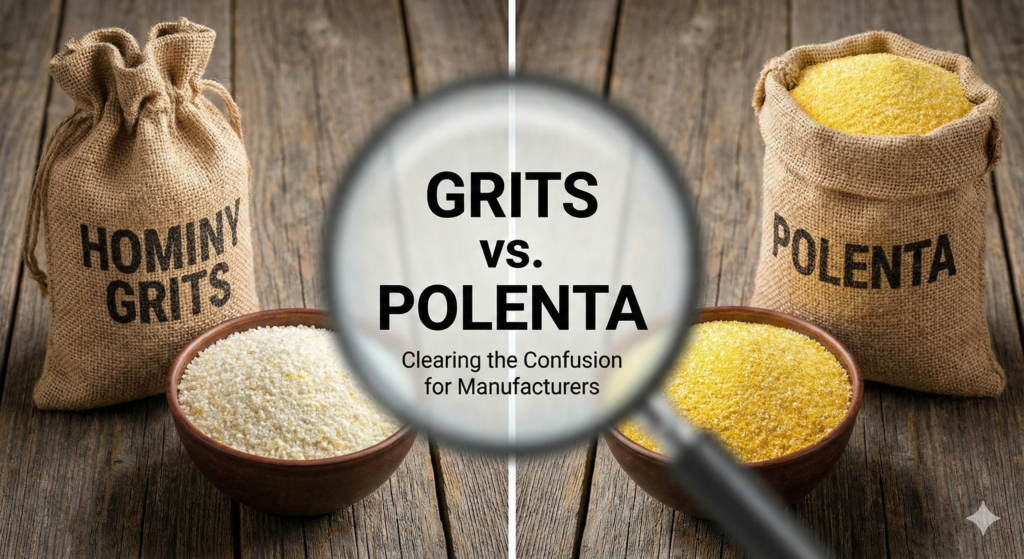
In the precise world of industrial ingredient sourcing, confusion is costly. A Purchase Order (PO) issued for the wrong SKU can lead to stalled production lines, ruined batches, and a product that fails to meet consumer expectations. One of the most persistent sources of confusion in the grain sector—even among seasoned procurement professionals and R&D scientists—is the distinction between two visually similar but chemically distinct maize products: Hominy Grits and Polenta (often simply sold as Standard Corn Grits).
To the naked eye, they appear identical: coarse, golden granules of milled corn. But under the microscope, and more importantly, in the dough mixer, they behave like two completely different species. Using one as a substitute for the other is not a minor tweak; it is a fundamental formulation error.
This definitive guide clears the fog. We will unpack the science of processing (Nixtamalization vs. Milling), the stark differences in flavor and functionality, and provide a clear roadmap for purchasing managers to ensure the right ingredient arrives at the loading dock every time.
1. The Tale of Two Processes: Mechanical vs. Chemical
The difference between these two ingredients isn’t the corn itself; it’s the journey the corn takes from the field to the factory.
Polenta / Standard Corn Grits: The Mechanical Path
Polenta (a term of Italian origin often used interchangeably with standard coarse grits) is the product of mechanical milling.
- The Process: Dried corn kernels are cleaned to remove foreign matter. They are then mechanically “degerminated” to remove the oil-rich germ and the bran. The remaining endosperm is ground into coarse, uniform granules.
- The Result: This is, essentially, raw corn. The starch granules are intact, and the protein structure remains tight and unaltered. It retains the natural chemistry of the corn kernel.
Hominy Grits: The Chemical Transformation
Hominy grits are the result of an ancient Mesoamerican process called Nixtamalization.
- The Process: Before any grinding happens, the whole dried corn kernels are soaked and cooked in an alkaline solution—typically water mixed with food-grade lime (calcium hydroxide).
- The Transformation: This alkaline bath is transformative. It dissolves the hemicellulose in the corn’s hull, causing the skin to slip off. More critically, it changes the corn at a molecular level. It alters the protein structure, partially gelatinizes the starches, and saponifies some of the fats.
- The Result: After washing and drying, these “nixtamalized” kernels (now called hominy) are ground into grits. This is no longer raw corn; it is a chemically modified ingredient with unique binding properties.
2. The Functional Divide: Binding vs. Crumbling
For an R&D team, this is the most critical section. The chemical differences described above dictate how the ingredient behaves when mixed with water.
Polenta (Standard Grits): No Binding Power
Because the proteins in standard corn grits are unaltered, they lack elasticity or binding power.
- Behavior: When you mix polenta with water, you get wet sand. It will not hold a shape. It relies on external binders (like eggs in a cornbread recipe) or the gelatinization of its own starch through boiling (like in a porridge) to create structure.
- The Application: It is perfect for boiling into a creamy mash (Italian Polenta), frying for a crunchy coating, or dusting onto pizza pans. It cannot be used to make a dough that needs to be rolled or pressed.
Hominy Grits: The Power of Masa
The nixtamalization process changes the proteins (zein) and starches so that they can bond with water and each other.
- Behavior: When you mix fine hominy grits (or hominy flour) with water, it forms Masa. This is a cohesive, pliable, plastic dough. It can be pressed into a thin disc, rolled into a ball, or shaped into a boat.
- The Application: This binding ability makes hominy the only choice for authentic tortillas, tamales, gorditas, and corn chips that are formed from dough (masa) rather than extruded. If you try to make a tortilla with standard polenta, it will crumble into dust on the press.
3. The Flavor Profile: Sweet vs. Savory Tang
The flavor difference is just as stark as the functional one.
- Polenta: Tastes like fresh, sweet corn. It has a simple, earthy, and nutty profile. It pairs well with sweet ingredients (honey, milk) or savory toppings (cheese, ragu).
- Hominy Grits: The alkaline lime treatment imparts a very distinct flavor. It is savory, slightly salty, mineral-rich, and has a unique “tang.” It has a toasted, complex aroma that is instantly recognizable as the scent of a fresh tortilla. It is a savory profile that does not work well in sweet applications.
4. The Nutritional Bonus: Unlocking Bioavailability
Hominy has a nutritional superpower that standard corn grits lack, a fact that can be leveraged in product marketing.
Corn is naturally high in Niacin (Vitamin B3), but in raw corn (polenta), this vitamin is chemically bound and unavailable to the human digestive system. The alkaline process of nixtamalization breaks these bonds, releasing the Niacin and making it 100% bioavailable. This process prevents the nutritional deficiency disease Pellagra. Furthermore, the corn absorbs some of the calcium from the lime water, significantly boosting the calcium content of hominy grits compared to standard grits.
5. Sourcing Checklist: How to Order Correctly
To ensure you receive the correct product, your procurement team should use specific terminology with your corn grit manufacturer.
| If you are manufacturing… | You need to order: | Specification Keywords: |
| Tortilla Chips, Tamales, Arepas | Hominy Grits / Masa Harina | Nixtamalized, Lime-Treated, Alkaline-Cooked, Masa |
| Extruded Puffs (Cheetos style) | Standard Corn Grits | Degerminated, Maize Grits, Hard Endosperm |
| Brewing Adjuncts (Beer) | Standard Corn Grits | Fat < 1%, Low Oil, Flaking Grits, Brewer’s Grits |
| Pizza Dusting / Release Agent | Standard Corn Grits | Coarse Grits, Polenta, Semolina (Corn) |
| Southern Style “Grits” (Porridge) | Either (Region Dependent) | Specify: “Hominy style” for savory/tangy, “Miller’s Grits” for sweet corn taste. |
Conclusion: Precision is Key
While they share a common ancestor in the corn field, Hominy Grits and Polenta are distinct culinary tools. One is the master of dough and authentic Latin flavor; the other is the king of porridge and brewing. Understanding this distinction prevents costly manufacturing errors and ensures that the final product—whether a crisp lager, a cheesy puff, or a soft taco—delivers the authentic experience the consumer craves.