

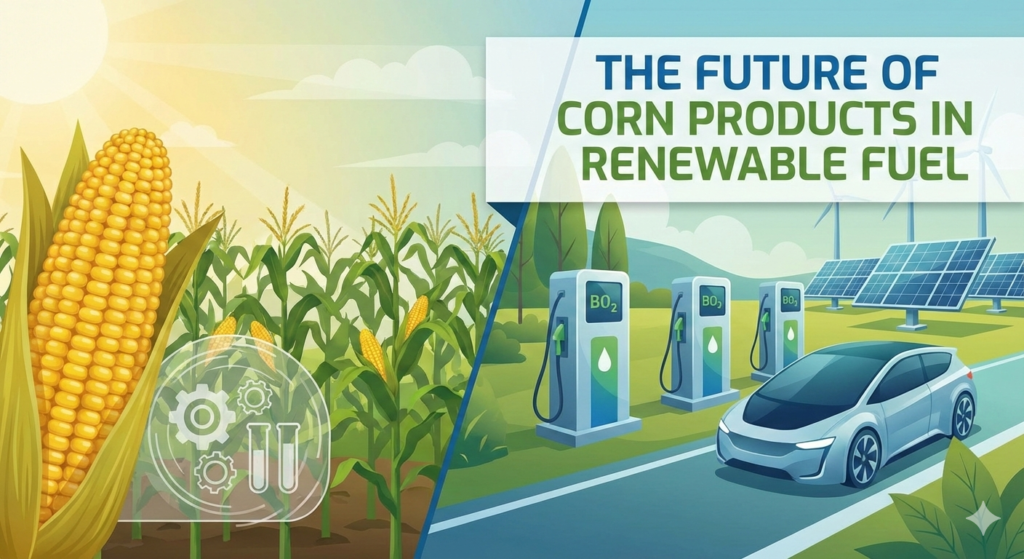
For decades, the conversation around corn and energy began and ended with ethanol blending in gasoline (E10 or E15). While this reduced reliance on fossil fuels, the energy landscape is shifting dramatically. The electric vehicle (EV) revolution is challenging the dominance of liquid fuels for ground transportation, forcing the corn industry to pivot.
The future of corn in energy is not vanishing; it is upgrading. We are moving toward a new era where corn is the feedstock for “hard-to-electrify” sectors like aviation and shipping. Through carbon capture technologies and advanced processing, corn products are positioning themselves as the premier low-carbon feedstock for the next generation of renewable fuels.
The Pivot to Sustainable Aviation Fuel (SAF)
The most exciting frontier for corn is the sky. Unlike cars, airplanes cannot easily run on batteries due to weight constraints. The aviation industry has committed to net-zero emissions by 2050, and Sustainable Aviation Fuel (SAF) is the only viable path to get there.
- The Chemistry: Alcohol-to-Jet (ATJ) technology allows producers to convert corn ethanol into a kerosene-like fuel that can be dropped directly into existing jet engines.
- The Demand: The demand for jet fuel is massive. If the corn ethanol industry can capture even a fraction of the aviation market, it would offset potential losses from the rise of EVs on the road.
- The Challenge: To qualify as SAF, the fuel must meet strict carbon intensity (CI) scores. This is driving a revolution in how corn is grown and processed.
Lowering Carbon Intensity (CI)
For corn-based fuel to survive in a policy environment obsessed with “Net Zero,” it must get cleaner. The future of corn fuel depends on Carbon Capture and Sequestration (CCS).
- At the Plant: Fermentation (the process of turning corn into alcohol) produces pure CO2 as a byproduct. Rather than venting this into the atmosphere, modern ethanol plants are capturing it and injecting it deep underground into saline aquifers. This drastically lowers the carbon footprint of the resulting fuel.
- On the Farm: Fuel producers are now paying premiums to farmers who use “climate-smart” practices (like no-till or cover crops). By lowering the carbon footprint of the corn before it reaches the factory, the final fuel becomes competitive with other renewables like wind or solar in terms of emissions lifecycle.
Cellulosic Ethanol: The Holy Grail
Current ethanol production primarily uses the starch of the corn kernel. However, the future lies in using the entire plant. “Cellulosic ethanol” involves breaking down the fibrous parts of the corn plant—the stalks, leaves, and cobs (corn stover)—into fuel.
- Efficiency: This approach turns agricultural waste into energy without requiring additional land to grow more crops.
- Technology Gap: While promised for years, the enzymes required to break down cellulose have been expensive. Recent breakthroughs in biotech are finally bringing the cost down, making commercial-scale cellulosic corn fuel a near-future reality.
Beyond Fuel: The Biorefinery Concept
The future corn fuel plant will look less like a distillery and more like an oil refinery. It will produce fuel, yes, but also a suite of high-value co-products.
- Corn Oil: Used for renewable diesel.
- High-Protein Feed: Optimized for specific livestock needs.
- Bioplastics: Using the carbon backbone of corn to create biodegradable plastics.
By diversifying, these facilities insulate themselves from the volatility of the oil market.
Conclusion
The narrative that corn ethanol is a “bridge fuel” that has reached its end is incorrect. Instead, corn products are evolving into a high-tech, low-carbon feedstock for the sectors that need liquid energy the most. Through the adoption of Carbon Capture, the expansion into Sustainable Aviation Fuel, and the utilization of corn stover, the corn industry is securing its place as a cornerstone of the renewable energy future.